
Artificial Intelligence is moving faster than most governance frameworks and that gap is what leadership needs to address.
In boardrooms and executive meetings, AI is no longer discussed as experimentation. It is being used to draft strategy documents, analyze financial trends, support hiring decisions and even shape communication. The shift is subtle but significant: AI is no longer at the edge of organisations, it is moving into the core.
This is what makes the moment different.
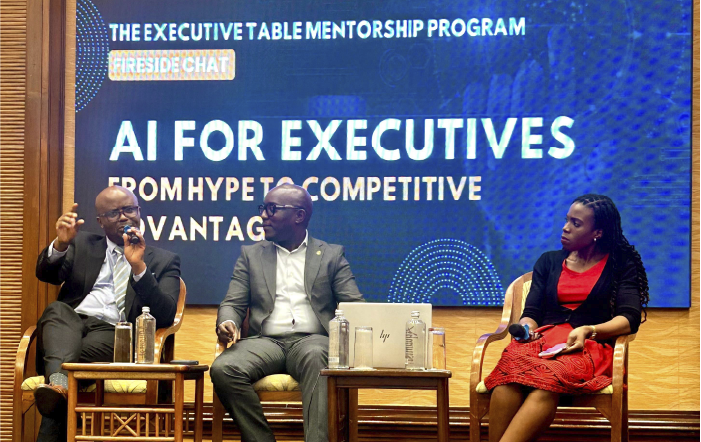
As highlighted during our recent AI fireside conversation, this is not just another wave of technology. AI cuts across every industry, every function and every level of decision-making. Unlike the internet, which connects information, AI interprets it. It synthesises, recommends, and increasingly influences judgment.
That changes the leadership mandate.
The Risk Isn’t AI — It’s Ungoverned AI
Most organizations are already using AI, whether formally approved or not. Teams are uploading documents, summarizing internal discussions, drafting proposals and analyzing sensitive data. Often, this happens quietly, without clear policy or oversight.
This is where governance becomes critical.
The risk is not that AI will replace leadership, it’s that leaders may unknowingly allow decisions to be shaped by tools operating outside defined boundaries. When sensitive documents are shared, when internal knowledge is processed externally, or when outputs are accepted without validation, organisations expose themselves to unintended consequences.
This is why frameworks such as Data Loss Prevention (DLP) are no longer technical considerations. They are strategic safeguards. They define what information can be used, how it is protected
and where accountability sits.
Governance is not about slowing adoption. It is about enabling responsible adoption.
Ethics Must Move from Principle to Practice
Ethical AI often sounds conceptual, but in reality, it shows up in very practical ways:
- Does your team know what data should never be uploaded into AI tools?
- Are AI-generated insights being verified before influencing decisions?
- Is there clarity on who owns AI-driven recommendations?
- Are leaders modelling responsible use themselves?
Without clarity, ethics remains theoretical. With clarity, it becomes operational.
The organisations that will benefit most from AI are not the ones using it the most, but the ones using it intentionally.
Education Is the Missing Layer
Policies alone cannot manage AI risk. Awareness must sit alongside governance.
Employees need to understand that AI outputs are probabilistic, not absolute. They need to recognize the difference between efficiency and accuracy. They need to know when to rely on AI and when to challenge it.
This is where leadership plays a defining role. When leaders prioritize education, they create confident, responsible users. When they don’t, teams either over-rely on AI or avoid it altogether, both of which limit value.
Responsible AI adoption is not just a technology rollout. It is a capability-building exercise.
The Executive Shift
AI is quietly reshaping what executive leadership looks like. Leaders are now expected to:
- Understand AI well enough to ask the right questions
- Establish governance without stifling innovation
- Protect organizational knowledge while enabling productivity
- Balance speed with accountability
This is not about becoming technical experts. It is about becoming intentional stewards.
Because the competitive advantage will not come from AI alone. It will come from how responsibly and strategically organisations use it.
The Bottom Line
AI is already embedded in how organisations work. The real differentiator now is governance.
Leaders who put guardrails in place early will build trust, protect value, and scale responsibly. Those who delay may find themselves managing risk after adoption has already spread.
AI is powerful. But power without governance creates exposure.
The organizations that will lead in this next era will not just adopt AI, they will govern it well.
Share This Story, Choose Your Platform!
CAPTIVATING READS

Our blog is packed with articles and stories based around lifestyle, business, design and wellbeing. Subscribe now to get all of our updated directly to your inbox every week.